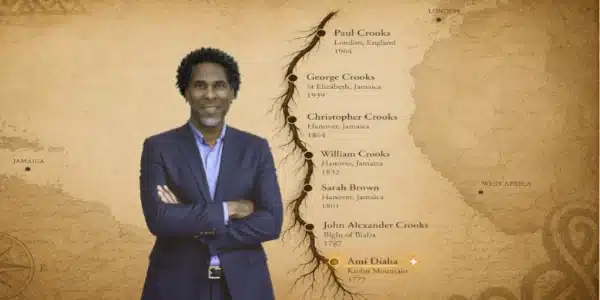
When your family history disappears in the records, where do you go next?

Most family histories affected by slavery break down in the archives.
This work focuses on reconstructing identity where records appear to fall short—and where historical context makes resolution possible.

Introduction

If you have tried to trace your ancestry and found that the records stop, change, or disappear, you are not alone.

Paul Crooks specialises in reconstructing identities shaped by slavery using historical records. His work addresses a central problem in African-Caribbean genealogy: how to trace ancestry when records are incomplete, renamed, or fragmented.

Drawing on British, Caribbean, and transatlantic archives, this work focuses not just on finding records—but on helping you understand what they mean when taken toge

From proof to method

When Ancestors was first published in 2002, tracing African-Caribbean ancestry through enslavement-era records was widely considered difficult, if not possible only within specialist research.

The book demonstrated that such reconstruction could be achieved using archival evidence, bringing this process into the public domain and establishing a foundation for wider genealogical research.

This marked a shift from uncertainty to possibility—showing that African-Caribbean ancestry could be traced where it had long been assumed lost.

This work was later developed into a structured approach in A Tree Without Roots, translating archival research into a practical process for individuals seeking to trace their ancestry.

Why tracing African-Caribbean ancestry is different

Standard genealogy relies on continuous records.

But for families shaped by slavery, those records often:

  • change names
  • break across generations
  • or disappear entirely

This creates gaps that conventional research cannot resolve on its own.

Reconstructing identity from fragmented records

This work focuses on helping you move beyond those gaps.

It is based on the Evidence–Context Reconstruction Framework, a structured approach to tracing identity where historical records are incomplete, inconsistent, or appear not to contain the answers.

By connecting records across time, place, and context, it becomes possible to reconstruct identity where the archival trail is incomplete—and, in some cases, to recover evidence that is not immediately visible on the surface of the records.

This includes understanding how factors such as local history, religion, and resistance shaped how identities were recorded.

Rather than treating records in isolation, the focus is on how evidence can be:

  • correlated
  • interpreted
  • and understood within historical context

Books and Publications

How can ancestry be traced when records are incomplete?

Published works explore how African-Caribbean ancestry can be reconstructed through archival research, case-based analysis, and historical interpretation.

→ Browse Books

Ancestry Talks

What do historical records reveal—and what do they hide?

Talks address the questions records alone cannot answer, exploring identity, naming, migration, and the reconstruction of ancestry where historical records are limited.

→ Explore the Talks

Case Studies

What happens when fragmented records are connected?

Case-based analyses demonstrate how historical evidence can be interpreted to reconstruct individual and family identities.

→ View Case Studies

Consultations

What if your research has reached a point where records no longer provide clear answers?

Consultations focus on resolving specific problems created by gaps in the historical record.

→ Consultations

This site is intended for libraries, institutions, educators, and individuals seeking an evidence-led understanding of Black genealogy and African-Caribbean history. The emphasis throughout is on archival literacy, methodological transparency, and responsible historical interpretation.

Who this site is for

This site is for:

  • Individuals seeking to understand their ancestry beyond the limits of records
  • Libraries and institutions presenting African-Caribbean history
  • Educators exploring identity through historical evidence

Expertise and Research Focus

Paul Crooks’ work focuses on reconstructing Black ancestry using archival evidence from British, Caribbean, and transatlantic records.

His research examines how identities shaped by enslavement and migration can be reconstructed despite gaps, inconsistencies, and fragmented documentation.

Through publications, case studies, and lectures, he demonstrates how historical evidence can be used to recover identities that were often obscured within record systems—and how those identities can be understood in context.