Trace Jamaican Ancestors: Rethinking the Origins of Surnames
A masterclass in interpreting how family names were formed across slavery, emancipation, and shifting identities.
Paul Crooks presents this masterclass regularly for research audiences in the UK and US. View scheduled dates
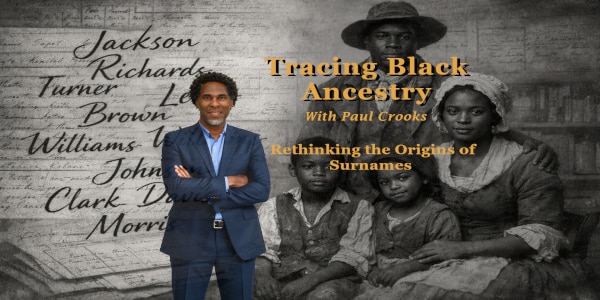
The Challenge: Why Surnames Don’t Trace as Expected
Many people tracing African-Caribbean and African American ancestry assume their family name can be followed in a clear, continuous line.
In practice, this is where many searches begin to break down.
Names change. Individuals appear differently across records. Connections that seem straightforward no longer align.
What appears to be inconsistency is not random. It reflects how names were formed, recorded, and used within systems shaped by slavery and its aftermath.
The issue is not simply missing records. It is that identity was not consistently preserved within the archive.
Surnames do not always function as stable markers of lineage. They reflect shifts in ownership, status, belief, and social context.
What appears to be a dead end is, in fact, a structural feature of how identity was recorded.
Rather than treating these patterns as errors, this session reframes them as part of how Black family history must be understood.
To explore the methodology of the 1880 Barrier in a live, interactive environment, view upcoming session availability:
UK Eventbrite | US Eventbrite
What You’ll Gain
- Surname Formation Context: A clearer understanding of how family names emerged within slavery and its aftermath
- Identity Across Records: Insight into why individuals appear under different names in historical documents
- Structural Interpretation: Recognition of why surnames do not follow consistent or traceable patterns
- Post-Emancipation Shifts: Understanding how naming practices changed under new social and cultural conditions
- Research Clarity: A more accurate way to interpret what your family name represents within the historical record
Who This Is For
- Those beginning to trace African-Caribbean or Black ancestry
- Individuals who have struggled to follow their family name through records
- Anyone researching African American or African-Caribbean family history
- Those seeking a clearer understanding of how identity appears in historical records shaped by slavery and migration
Registration
Information on upcoming dates and registration for this talk is available through Eventbrite.
This session forms part of a wider series of Evidence-led talks on identity, history, and interpretation
Current schedule of evidence-led talks on identity and ancestry: UK Dates | US Dates