Tracing Jamaican Ancestry: Help When Records Stop Making Sense
A masterclass in understanding the historical forces behind your records—and what they reveal about your ancestry.
Paul Crooks presents this masterclass regularly for research audiences in the UK and US. View scheduled dates
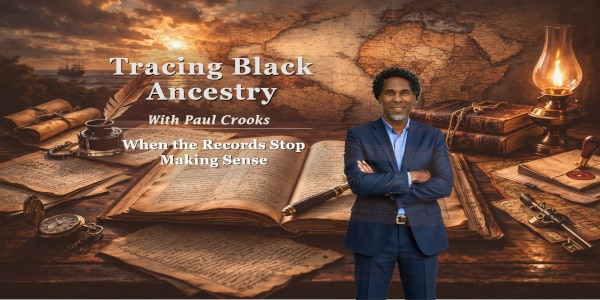
The Challenge: When Records Confirm—but Do Not Explain
Most people tracing Black ancestry reach a point where records stop explaining what they are seeing. Names change. Identities shift. Records exist—but they no longer provide a clear account of how individuals came to be in the positions recorded.
Moments appear in the archive, but the conditions that shaped them are not visible.
When tracing his own ancestry, Paul Crooks identified an ancestor walking free from a Jamaican plantation in 1838. The records confirmed the moment—but did not explain how that individual came to be there, or what had shaped the world he entered.
This is often treated as a limitation of the records themselves.
In reality, it reflects the absence of the historical conditions that shaped those records.
These gaps are not simply missing details—they are the result of forces that operated outside the record but shaped what was recorded within it.
The conditions surrounding slavery, resistance, and colonial instability influenced how lives were lived, how identities were formed, and how individuals later appeared in the archive.
Without that context, records can confirm events—but not explain them.
Rather than treating this as a failure of research, this session reframes it as a structural feature of the evidence—requiring a different way of understanding what records represent.
To explore the methodology of the 1880 Barrier in a live, interactive environment, view upcoming session availability:
UK Eventbrite | US Eventbrite
What You’ll Gain
- Historical Context Clarity: A clearer understanding of the forces that shaped what appears in your records
- Record Interpretation: Insight into why records confirm events but do not explain them
- Identity Formation Perspective: Recognition of how historical conditions influenced identity, movement, and documentation
- Structural Understanding: A more accurate view of why records appear incomplete or difficult to interpret
- Reframed Research Perspective: Clarity on what this stage represents within your ancestry research
Who This Is For
- Those tracing African-Caribbean or Black ancestry
- Individuals whose research has reached a point where records no longer explain what they are seeing
- Anyone seeking to understand what shaped their ancestors’ lives—not just identify them
- Those looking for a clearer interpretation of how slavery and emancipation affected identity
This session forms part of a wider series of Evidence-led talks on identity, history, and interpretation
Current schedule of evidence-led talks on identity and ancestry: UK Dates | US Dates