Tracing Windrush Ancestry: What Passenger Lists Really Show
A masterclass in understanding how passenger lists function within Black ancestry research across migration.
Paul Crooks presents this masterclass regularly for research audiences in the UK and US. View scheduled dates
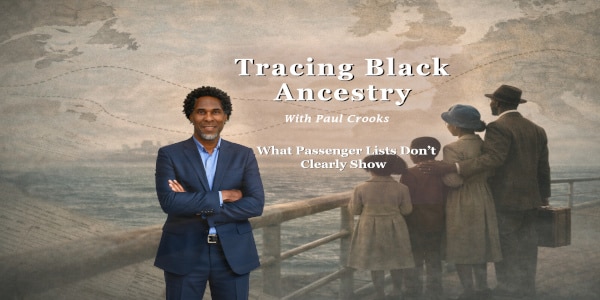
The Challenge: Why Passenger Lists Don’t Connect the Records
Passenger lists are often treated as straightforward records of travel—expected to link individuals across countries and move family history forward.
In practice, they rarely function this way.
They sit alongside other records but do not easily connect in a way that explains how individuals relate across different places. What should clarify movement instead introduces uncertainty.
This is not because the records are incomplete. It reflects the role passenger lists were designed to serve.
Passenger lists do not record identity in a way that preserves continuity across borders.
They capture moments of movement, but not the full context needed to connect individuals across different record systems.
Within Windrush and wider Black ancestry research, this creates a structural gap—where records exist in multiple countries, but do not align in a way that allows progress to continue clearly.
Rather than treating this as a failure of documentation, this session reframes passenger lists as part of a wider evidential landscape—useful, but limited in how they connect identity across migration.
To explore the methodology of the 1880 Barrier in a live, interactive environment, view upcoming session availability:
UK Eventbrite | US Eventbrite
What You’ll Gain
- Passenger List Function: A clearer understanding of what passenger lists actually record—and what they do not
- Cross-Border Disconnect: Insight into why these records do not connect easily with others across countries
- Limits of Movement Records: Recognition of why travel records alone rarely move research forward
- Migration Context: A more grounded understanding of how ancestry spans multiple places without aligning clearly
- Research Clarity: A more accurate way to interpret what passenger lists represent within Black ancestry research
Who This Is For
- Individuals with Caribbean family roots in Britain or the United States
- Those tracing African-Caribbean ancestry across the Caribbean, UK, or US
- African American researchers with Caribbean family origins
- Anyone whose research has stalled across countries
- Those seeking to understand why records exist but do not connect
This session forms part of a wider series of Evidence-led talks on identity, history, and interpretation
Current schedule of evidence-led talks on identity and ancestry: UK Dates | US Dates