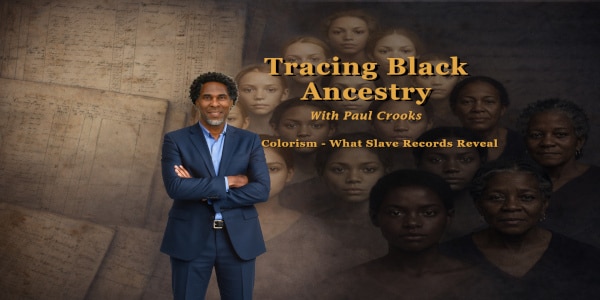
Tracing Black Ancestry: Colorism — What Slave Records Reveal
This masterclass examines how slavery-era records reflect the origins of colorism and how identity was constructed within them.
Paul Crooks presents this masterclass regularly for research audiences in the UK and US. View scheduled dates
The Challenge: When the Trail Appears to End
Colorism is often understood as a matter of personal attitude or social preference. But within slavery-era records, distinctions in skin tone and status were formally recorded as part of systems that classified people in hierarchical terms.
These descriptions were not neutral. They reflected how individuals were valued, categorised, and controlled. Terms used to describe people could shift depending on context, record type, or the purpose of the document.
As a result, identity does not appear consistently across the archive. The same individual may be described in different ways from one record to another. What appears inconsistent is often a reflection of how identity was defined within these systems.
For those tracing African-Caribbean or African American ancestry, this creates a point where records stop connecting in a clear and continuous way. The issue is not simply missing information, but how identity itself is represented within the records.
To explore the methodology of the 1880 Barrier in a live, interactive environment, view upcoming session availability:
UK Eventbrite | US Eventbrite
What You’ll Gain
- A clearer understanding of how slavery-era records reflect the origins of colorism
- Insight into how classification systems shaped identity within historical records
- Greater clarity on why identity does not appear consistently across documents
- A stronger understanding of why standard genealogy approaches reach their limits
- A more accurate perspective on how colorism affects the interpretation of ancestry
Who This Is For
- Those tracing African-Caribbean or African American ancestry
- Individuals whose research has reached a point where records no longer align
- Anyone working with slavery-era or post-emancipation records
- Those seeking a clearer understanding of how identity is represented within historical documentation
This session forms part of a wider series of Evidence-led talks on identity, history, and interpretation
Current schedule of evidence-led talks on identity and ancestry: UK Dates | US Dates